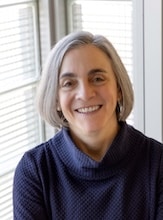
 Editor’s Note: Kevin recently spoke with Cait DesRoches, who was named Principal Investigator for the Society of Participatory Medicine’s signature project, CHAMP, the Collaborative Health Care Action Measurement Platform.
Kevin Freiert: Cait, can you tell us a little bit about yourself and your current work?
Cait DesRoches: My name is Cait DesRoches. I’m a researcher and a faculty member at Beth Israel Deaconess Medical Center in Boston. I lead the OpenNotes Initiative, which is a group of clinicians, researchers, patients, care partners all focused on the idea of how can we use transparency, particularly information transparency for patients, to improve care. That work involves a lot of pilot studies to see what’s the best way to do this? How do we know that it’s working? What is important for patients? What’s important for clinicians? As we move through this new world where patients have access to their health information at their fingertips.
Kevin: It’s a fantastic initiative and it’s starting to grow. What has your work on OpenNotes taught you about the value of participatory medicine?
Cait: Transparency, a foundational piece of participatory medicine.
If clinicians and patients are not on the same page, if they’re not working off the same set of information, then there’ll always be a power differential between the patients and the clinicians. If I go to the doctor, and I don’t understand what that doctor is thinking or what they are planning for my care, because it hasn’t been shared with me, then I literally can’t participate in it.
And then from there, we need to create an environment in which patients and families are empowered to take that information and really engage with it and really use it to participate with the clinicians in understanding their own care, understanding their own health, and making decisions together about what needs to happen.
Kevin: Absolutely. As you get started working on the CHAMP project, it’s a measurement platform. So why do you think we need to measure the “participatoriness” that we see out there in the world?
Cait: That’s a great question. In the world of healthcare, we measure everything. We measure how many people got their screenings. We measure how many people were readmitted to the hospital. All of those things are measured because we want to improve them. Either the healthcare system is getting an incentive to hit a target or a disincentive not to hit a target.
But without measurement, we don’t know where we are and then we can’t work to improve it. So, it’s key to have a valid way to say to an organization, “Hey, here’s where you are at your baseline. Here are strategies to help you improve. And here’s where we are going to come back and measure again next year and see how you’re doing.” We want to give organizations and patients a way to see, “Am I making progress?” Without that measurement, we just have no idea.
Kevin: So that’s great explanation of what we’re trying to measure and sort of why. But in the bigger picture, what are you hoping that we will achieve by establishing CHAMP?
Cait: Yeah, when you take the time to carefully design a tool to measure something, it means that that thing is important. So by making the thing important, it becomes a story that can start to spread.
The measurement is not the goal. The measurement is to have organizations say, I want to get an A on that thing, or to have patients say, I want to improve my own readiness to participate. Putting a number on something, giving something a score just helps to impart the idea that you ought to be paying attention to this.
Kevin: Yeah, like I’m obsessed with my sleep scores now. And it’s just a number.
Cait: That’s right. Why do I think our phones tell us how many steps we’re taking? Because we want to know how we are doing and without a number, without some kind of a measurement, it’s hard to know on a population level how we’re doing.
Kevin: Exactly.
That introduces another question. What are some of the benefits that collecting and disseminating data about the actions that patients and their providers take to work as a team? What are the benefits we hope to see as they change their behaviors?
Cait: We know from a lot of research that patients who are more engaged in their care do better. They have better outcomes. But we also know that engagement is challenging for patients. We know the environment does not encourage it. It’s rare for a healthcare organization. And not because they’re run by terrible people, but this is a business. Healthcare is a business. So, it’s rare to have an organization really prioritize creating the conditions that allow for a participatory relationship between a patient and a clinician.
But we know that engaged patients do better. We want to create… help to create those environments.
So…
I would expect to see in a really participatory environment that patients are doing better. They feel more in control of their care. They feel more ready to engage in shared decision-making. They understand what they’re supposed to do next and not only what they’re supposed to do next, but how they’re supposed to do it, with supports in place to help them do it. Those are the things that I would expect to see.
And I know that the industry is interested in hard clinical outcomes like whether blood pressure is under better control or hemoglobin A1c scores are better. But what I expect to see first is a cultural shift. And that cultural shift is just as important as those hard outcomes, which I think we could get to. But first, I would expect to see just an environment that encourages participation.
Part 2 of this interview can be found here: https://wp.me/p8S1TQ-61K.

What stands out most in this conversation is the quiet but powerful reminder that care only becomes whole when information is shared, not held back.
When patients and clinicians work from the same understanding, something shifts. The relationship moves from “being told” to “working together.” That is where trust deepens, and where people can truly take part in decisions about their own health.
I appreciate the emphasis on transparency as more than a principle, but as a practice that needs intention, structure, and measurement to sustain it. What we choose to measure signals what we value. And when we measure participation, we are saying that voice, understanding, and partnership matter in the same way we measure clinical outcomes.
It also matters deeply who is guiding this work. Having Cait DesRoches leading CHAMP brings both clarity and credibility to the effort. Her commitment to OpenNotes and to making information genuinely usable for patients and clinicians has already helped shift how we think about access and trust. This next chapter feels like a natural and important extension of that work.
The idea that engagement leads to better outcomes is not new, but the reminder here is important. Engagement does not happen by chance. It requires conditions that support it.
Time, clarity, and a willingness to see patients and families as active partners in care.
Before any metrics improve, there is something more human that must take shape first. A culture where people feel informed, included, and capable of showing up in their own care.
That is the work.
This is a great initiative – thank you. As a person with the familial form of a rare condition (MdDS) I have been working in the UK rare conditions space on and off for several years, wrote a What your Patient is Thinking piece for the BMJ (Healthy Approaches to Rare Conditions) and was a guest blogger for Findacure (now Beacon for Rare Diseases) for a while, under the title of ‘treasure your exceptions’.
Several themes emerged including that getting diagnosed involved an element of luck and that initial misdiagnosis with vague, psychiatric labels was/is common, that accessing genetic Profs and counselling is hard (I got there eventually but only through luck) and, crucially, that people with rare conditions often have a high level of inaccuracies and omissions in our medical records. In the UK we have the right to accurate records but since it took me a lot of toxic pro bono admin – and several years – just to get the correct date of my diagnosis recorded in my notes I am unlikely to have time to get the many other inaccuracies corrected and I know this is a similar issue for others with rare conditions. As such I hope that your research can include as much outreach to people with rare conditions – and the doctors who care for us – as possible.